
Two exact mixtures. Can you find a third?
I’m looking for someone who works on black-hole perturbation theory to take a hard look at Aptifold’s scattering preprint. I’d start with the step that rules out a third solution.
Where the shortcut comes from
When two waves of the same frequency scatter from a nonspinning black hole, their interaction drives a new wave at twice the frequency. Ordinarily, you calculate that response by integrating the driving term over the exterior. In the highest angular channel, we found two choices of the incoming odd and even components for which a local expression does the integration. Once you impose the radiation conditions, the outgoing wave follows from the linear reflection amplitudes.
The word exactly is the part I most want checked. After you subtract the two local expressions, any third mixture leaves a piece of the bare odd–odd source. The proof reduces every rational candidate to 30 coefficients, then exhibits a combination of 41 equations that kills the contribution from all 30 coefficients while retaining a nonzero piece of that source. A missed pole, a change in source conventions, or a gap in the move from formal coefficients to one fixed physical input wave could change that argument.
A small response makes a good sign test
At ℓ = 4 and Mω = ½, the square of the even parent reflection supplies one complex term and the odd daughter reflection supplies the other. Each is about 48 times larger than their sum. That leaves room for a seemingly small sign or phase error to dominate the answer. Try adding one degree to the daughter term in the Lab and watch the sum move.
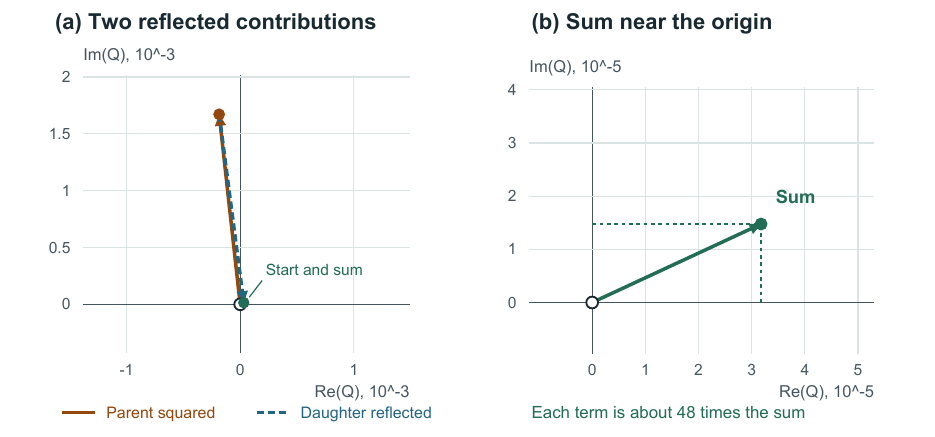
The enclosed direct and closed results differ by at most 1.09 × 10⁻²⁰ in normalized complex strain for those shared input waves. That comparison gives future calculations a stringent reference for phase, normalization and boundary conditions in this setting. Extensions to spinning black holes or unequal parent frequencies would need their own derivation and tests.
What I’d ask a reviewer to check
- Rebuild the forcing. Start with Bucciotti and colleagues’ pinned second-order source. Check the identical-parent factor, odd phase convention and daughter projection before comparing the bare odd–odd coefficient array.
- Challenge the exclusion. Look for a rational candidate outside the Laurent bounds, a flaw in the fixed-parent argument or an allowed parameter value where the witness fails.
- Recompute the complex response. Use your own linear waves and radial solver if you can. At the ℓ = 4 benchmark, compare each reflection term, the real and imaginary parts of the sum, and the response when you reverse the daughter sign.
If you find a discrepancy, or can suggest a better test, please get in touch. An equation number, the conventions you used and the first quantity that disagreed would help us reproduce it. A short note on one of these steps would be valuable.
Where I want Aptifold to go
Aptifold helped formulate the question, derive the local expressions, develop the exclusion and write the formal checks. I want to use systems like this to shorten the time between an idea and the moment someone else can test it. A person with a different solver or a better reading of the physics should be able to find the exact assumption, change it and show us where the result moves.
That is why we’ve put the paper, the controls, the source and the replay on the same path. Lean gives reviewers a precise statement of what the formal proof establishes. Domain experts can decide whether it captures the intended physics. Their corrections are part of how this work can get better.
Second-order scattering calculation by Bucciotti et al. · Read the illustrated explanation